Fikashu: A Refined Script Font for Elegant Brand Identity
It started with a blank mood board and a client email: “We’re opening a small-batch botanical skincare studio—quiet, intentional, handmade. The name is soft, the ingredients are local, and the vibe? Calm luxury.” I opened my font library, scrolled past the usual suspects, and landed on Fikashu. Not because it was trending—but because it *felt* like the first quiet breath before a well-designed logo locks into place.
Fikashu for Skincare Branding and Minimalist Packaging Design
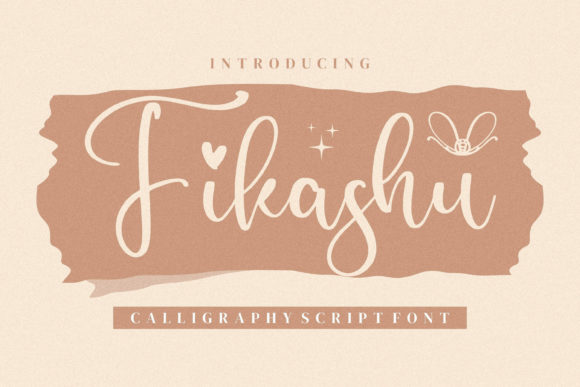
Fikashu is a Script Handwritten font that doesn’t shout—it leans in. Its letterforms have delicate contrast, graceful entry and exit strokes, and just enough texture to feel human without sacrificing polish. As a Fonts choice for this skincare project, it immediately elevated simple product names (“Lavender + Chamomile Serum”) from functional labels to tactile moments of pause. I tested it on matte kraft labels first: the way the lowercase “g” curls, the subtle lift in the “t” crossbar—it translated beautifully to print. No ink bleed, no loss of nuance. Because Fikashu is a chic, refined script font that emanates sophistication and elegance, it anchored the entire visual language—not as decoration, but as quiet authority.
Fikashu for Logo Design and Signature Wordmarks
For the studio’s wordmark, I avoided stacking or heavy kerning. Instead, I leaned into Fikashu’s stylish alternates and ligatures—swapping the default “a” for its more open, airy alternate, connecting “o” + “n” with a soft, organic ligature that mimicked the flow of handwritten calligraphy. The result? A logo that reads clearly at 24px on a website header *and* holds presence engraved on a ceramic jar lid. This isn’t a font built for body copy—it’s a display font, a logo font, a headline font—designed for moments where tone matters more than volume. And because Fikashu is PUA encoded which, accessing those alternates in Illustrator or Figma was seamless—no digging through glyphs panels or installing extra files.
Fikashu for Social Media Graphics and Editorial Storytelling
I used Fikashu across Instagram carousels and newsletter headers—not for captions, but for pull quotes and ingredient highlights (“Cold-Pressed Rosehip Oil • Batch #027”). Paired with a warm, low-contrast serif (think: a gentle Garamond variant), Fikashu created hierarchy without hierarchy shouting. It gave warmth to clinical-sounding terms like “phytosterols” and “ceramides,” turning science into story. As a Script Handwritten typeface, it added humanity without leaning into cutesy or overly casual territory—a fine line many Fonts miss when aiming for “handmade” appeal. On mobile, the letter spacing stayed legible; on desktop, the ligatures added rhythm. Real usability, not just aesthetic flair.
Fikashu for Business Cards and Printed Brand Collateral
Business cards were where Fikashu surprised me most. Printed on thick cotton stock, its fine details held up—especially the tapered terminals and delicate swashes. I kept the layout sparse: name in Fikashu, title in a crisp sans serif, and nothing else. That contrast—soft script + clean geometry—communicated the brand’s duality: rooted in tradition, designed for now. Clients noticed it instantly. One said, “It feels like something you’d find tucked inside a linen pouch—not slapped on a plastic bag.” That’s the power of choosing the right script font: it becomes part of the unspoken brand narrative before a single sentence is read.
Fikashu for Website Headers and Digital Brand Consistency
In the site build, I applied Fikashu only to H1s and hero section subheads—never body text, never navigation. Why? Because Fikashu is a chic, refined script font that emanates sophistication and elegance, and that energy works best in short bursts. I paired it with a neutral, slightly rounded sans serif for all UI text (buttons, forms, footer links), ensuring accessibility and speed. The combination felt intentional, not arbitrary. And thanks to its PUA encoding, swapping alternates for A/B testing headlines took seconds—not hours. For designers building digital-first brands, that kind of efficiency matters: Fikashu isn’t just beautiful—it’s *workable*.
Fikashu for Wedding Invitations and Elegant Branding
Even though this was a skincare project, I couldn’t help but test Fikashu against another classic use case: wedding stationery. I mocked up a suite—invitation, RSVP card, menu—and the results confirmed what the description promised: Fikashu’s stylish alternates and ligatures make this font the perfect match for any project. The “&” ligature flowed like ink on watercolor paper; the capital “S” had just enough flourish to feel ceremonial, not fussy. It’s rare to find a Script Handwritten font that balances personality with professionalism so effortlessly—especially one that scales cleanly from 12pt envelope addressing to 60pt ceremony signage. If you're sourcing Fonts for high-touch, emotionally resonant work, Fikashu earns its place in the toolkit.
Fikashu for Product Labels and Small-Batch Craft Branding
On actual product stickers—3-inch circular die-cuts—the lowercase “y” and “j” held their shape without thinning out. That’s critical for small-batch makers who print locally or use home label printers. Fikashu didn’t need heavy outlining or shadow tricks to stay legible. Its natural stroke variation is calibrated—not exaggerated—so it reads as premium, not precarious. When paired with a muted color palette (oat, sage, clay), it reinforced authenticity. No stock-font sterility. Just calm, considered typography doing quiet, confident work.
If you’re selecting Fonts for a brand that values craft, clarity, and quiet confidence—Fikashu isn’t just an option. It’s the kind of Script Handwritten typeface that makes clients pause mid-scroll and say, “Yes—that’s *us*.” It’s elegant without being distant, refined without being cold, and deeply usable without sacrificing soul. Whether you're designing for skincare, ceramics, editorial, or slow-living studios, Fikashu delivers the kind of typographic intention that turns visual identity into emotional resonance.